

There was no shortage of opinions about artificial intelligence at Becker’s 11th Annual Health IT + Digital Health + RCM Conference. But underneath the demos, use cases and predictions, a more interesting shift was taking place.
The conversation is becoming less about what technology can do and more about what healthcare organizations can realistically do with it.
Can an AI investment produce measurable value? Can the workflow absorb the asks? Who owns the investment outcomes? What happens when more data creates more responsibility? And perhaps the hardest question of all: Are health systems willing to pump the brakes on something when it doesn’t deliver?
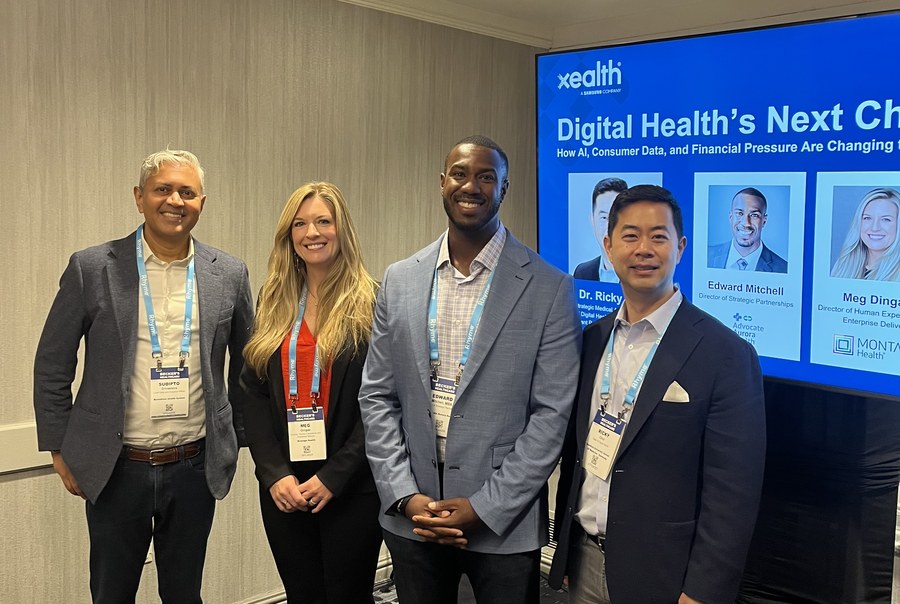
Those questions came up again and again in conversations throughout the week—including a candid discussion among health system leaders during Xealth’s executive roundtable on digital health’s next chapter.
Here are five ideas we’re still thinking about:
Digital Health Has Entered Its Accountability Era
Healthcare’s appetite for innovation hasn’t disappeared. But its tolerance for innovation without a clear purpose has.
Edward Mitchell, Director of Strategic Partnerships at Advocate Health, offered a useful contrast. During the early days of COVID, he remembers health systems “literally throwing spaghetti against the wall” as they raced to get digital tools into the hands of patients and clinicians.
That period served a purpose. But it also left health systems with lessons about what happens when tools proliferate faster than the infrastructure and workflows needed to support them.
Today, digital is table stakes for patients. At the same time, Mitchell noted, the financial reality makes it much harder to justify another isolated point solution. Technology has to fit the clinical workflow, connect to enterprise priorities, and be able to scale.
Meg Dingae, Director of Human Experience and Enterprise Delivery at Montage Health, sees the same evolution. What was once “a bunch of tools” operating in silos is increasingly expected to function as a connected ecosystem, integrated with the EHR and aligned to strategic priorities.
It’s a shift reflected in recent research from Xealth and Sage Growth Partners. While health systems and physicians remain enthusiastic about digital health, the research found important gaps in how executives and clinicians think about workflow, adoption and success. More than half of physicians identified workflow integration as the most important prerequisite for clinical utility, while only one-third of executives identified clinician adoption and workflow integration as a key measure of digital health. Nearly half of physicians also cited additional workload as a potential barrier to broader adoption.
Those gaps become even more consequential as AI dramatically expands what health systems could deploy. The challenge is shifting from adding technology to creating the infrastructure, governance and shared measures needed to turn innovation into something that can actually work at scale.
The question is no longer simply, Can we do this? It’s Should we do this—and what would make it worth doing?
2. ROI Is Becoming a Team Sport
One reason that question is a conundrum: Healthcare still doesn’t have one definition of value.
A CFO may look for revenue or cost savings, while an operational leader evaluates throughput, and a clinician values time returned to their day.
Ambient documentation is one example. Dingae doesn’t look at its value solely through direct revenue. Recruiting physicians to the Monterey Peninsula is resource intense, so retention itself is strategically important. If ambient technology reduces burnout and makes physicians’ working lives better, that matters, she said.
Advocate saw the value appear in several places across the org. Mitchell said physician satisfaction increased, patient satisfaction improved incrementally and clinicians saved time. Some used that capacity to see additional patients. Others told his team that the time simply allowed them to take a break.
It’s clear that value is increasingly being defined—and owned—across functions.
At Montage, the clinical, operational and HIT teams involved in an initiative develop a project charter together, agreeing upfront on what success looks like and who will be responsible for sustaining it.
That may be where ROI is heading—not toward one perfect metric, but toward greater discipline around agreeing on value before the work begins.
3. Healthcare Needs to Get Better at Subtraction
Sudipto Srivastava, Chief Data and Analytics Officer at Montefiore Health System, shared his thoughts around one of healthcare’s longstanding innovation problems. “We are really good at addition. Add more, add more, add more. We’re not good at subtraction,” he said.
Digital transformation has largely rewarded addition, panelists agreed, meaning a new problem is often solved with a new tool, a new opportunity with a pilot launch. The result is that starting something is often easier than stopping it, they said.
Srivastava is trying to introduce more discipline into that equation. Larger AI initiatives at Montefiore receive intense ROI scrutiny upfront. The next step is to go back three or six months later and compare the results with what was promised, he said.
f the initiative didn’t produce the projected return or improve productivity, for instance, Srivastava says there should be an open dialogue about willingness to stop.
As AI dramatically expands the number of things health systems could do, the ability to subtract may become every bit as important as the ability to innovate.
4. AI Can Speed Up the Work, But Can the Workflow Keep Up?
Moderator Dr. Ricky Choi, Xealth’s Strategic Medical Advisor, offered up one analogy for what happens when AI speeds up the work, but human workflows remain largely the same: the famous I Love Lucy chocolate factory scene. The conveyor belt gets progressively faster, but Lucy can only work so quickly.
Healthcare faces a similar challenge with AI. Making one task dramatically faster doesn’t necessarily create more capacity if the next step still requires a clinician to review information, make a decision, or communicate with a patient or coordinate follow-up. Sometimes, AI doesn’t eliminate the bottleneck—it just moves it.
That distinction will become increasingly important as AI moves beyond discrete tasks and into workflows that span operations, access, navigation and care delivery.
If faster output simply creates more work somewhere downstream, health systems haven’t necessarily gained capacity. The real opportunity is to redesign the surrounding workflow so that AI’s speed translates into better throughput, less friction or more time for the work only people can do.
5. More Data Isn’t the Goal—But Better Decisions Are
The same logic applies to data. Wearables, remote monitoring, consumer devices and AI are giving health systems access to more patient information than ever. But simply adding more signals to the system doesn’t necessarily make them useful.
In fact, more data can create more responsibility. If a wearable flags a meaningful change in a patient’s condition, who sees it? How is it filtered? Who is responsible for acting on it—and how does that action fit into a workflow that is already full?
That tension surfaced throughout the discussion. Dr. Choi pointed to Xealth’s recent research showing that physicians are increasingly open to incorporating wearable-generated data into clinical decision-making. The harder challenge is making that information actionable without creating another inbox, alert stream, or burden for clinicians.
That’s where AI may have a particularly practical role to play: not generating more information, but helping health systems organize it, identify meaningful changes and surface what requires attention. The opportunity is to turn a growing volume of patient data into the right signal, for the right person, at the right time.
As digital health shifts from experimentation to execution, staying ahead requires more than innovation—it requires orchestration. Follow Xealth here for insights on how leading health systems are scaling digital solutions that work, or connect with us at bizdev@xealth.com.