

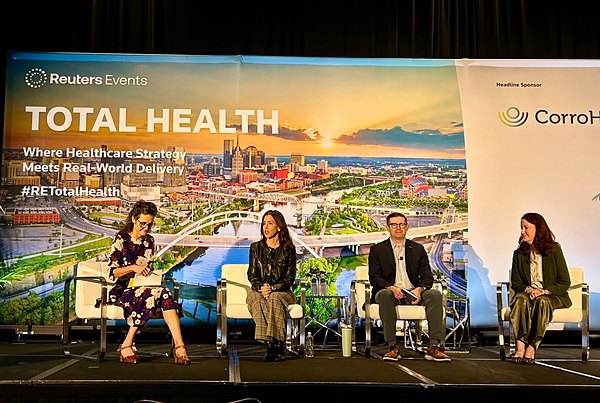
Reuters Total Health took over Nashville last week under the theme “Where Healthcare Strategy Meets Real-World Delivery.” During one and a half days of sessions and conversations, executives from leading health systems, payers, and innovators shared insights into how they are breaking barriers and transforming care delivery.
The headwinds facing healthcare are clear and, with midterm elections next week, many questions linger. Prior authorizations, making the patient experience more seamless through virtual care, and spotlighting innovation opportunities throughout the healthcare ecosystem with AI were particular areas of focus.
Improving the Patient Experience Through Smarter Data Collection
Eduardo Conrado, CEO of Ascension Health noted that the average time to turnaround a prior authorization is 3.7 days, and the information needed to secure approval is becoming harder to obtain.
Dennis Matheis, CEO of Sentara Health noted that there are missed opportunities on the front-end to collect more information from patients. Not only would that reduce costs for health systems needing that data later, it would also improve the patient experience – possibly even removing the need for prior authorizations. For patients and families, uncertainty about prior authorization and cost add stress to navigating care.
Virtual Care is Not Its Own Thing
A focus on a more seamless patient experience carried into several discussions about virtual care. One takeaway that wove its way into several sessions is that virtual care is now part of care delivery with organizations integrating previously stand-alone virtual teams into broader care teams.
Examples ranged from virtual visits for discharge planning to virtual tools in patient rooms that can detect fall risks. These applications show how virtual capabilities can support care throughout the patient journey while helping organizations make better use of clinical resources.
Even with these use cases and even when the right care is delivered at the right time, there are areas for rethinking the process. It’s not just ushering a patient through the right pathway. Innovation involves creating a new option that was not present before.
Designing Innovation Around Patients and Care Teams
AI offers several practical examples for building innovation throughout the healthcare ecosystem. Rural providers are using it to write a response to a payer that overturns a denial, and to create radiology worklists. Some providers are also finding that AI supports a better work-life balance. Turning those gains into sustainable improvements requires involving the right people in workflow design, pilots, and ongoing monitoring to ensure tools perform as intended.
That same attention to design applies to the patient journey.
Jodi Rosen, vice chair of digital strategy and business operations for the Mayo Clinic, recommends designing a journey that is agile, flexible, and right for each patient. Technology should create access for patients and capacity for providers. Rosen noted that having governance in place can be a catalyst and accelerate good work as it establishes a trusted framework to move forward.
Care pathways emerged as a particularly promising area for meaningful innovation. Earlier signals from wearables, preventative care, connectivity, and better data can help teams identify needs and act sooner, with payer support for prevention reinforcing those efforts.
Transparency was another thread connecting operational improvements with patient experience. Mark Cuban, founder of Cost Plus Drug Company, advocated for transparent, consistent pricing, likening healthcare’s lack of transparency to the first rule of Fight Club: nobody can talk about it.
Beyond the education sessions, one highlight was the Women in Healthcare Networking Event, which brought together dozens of influential women leaders for community and conversation. Participants shared experiences, challenges, and successes, along with ideas for helping advance the next generation of healthcare leaders.
The conversations in Nashville reinforced that turning strategy into better care requires connecting technology, people, and workflows across the patient journey. At Xealth, we help health systems put digital care into action by integrating digital solutions into clinical workflows, automating personalized engagement, and measuring what works. The goal is to expand access, reduce operational burden, and deliver measurable value for patients and health systems.
As digital health shifts from experimentation to execution, staying ahead requires more than innovation—it requires orchestration. Follow Xealth here for insights on how leading health systems are scaling digital solutions that work, or connect with us at bizdev@xealth.com.